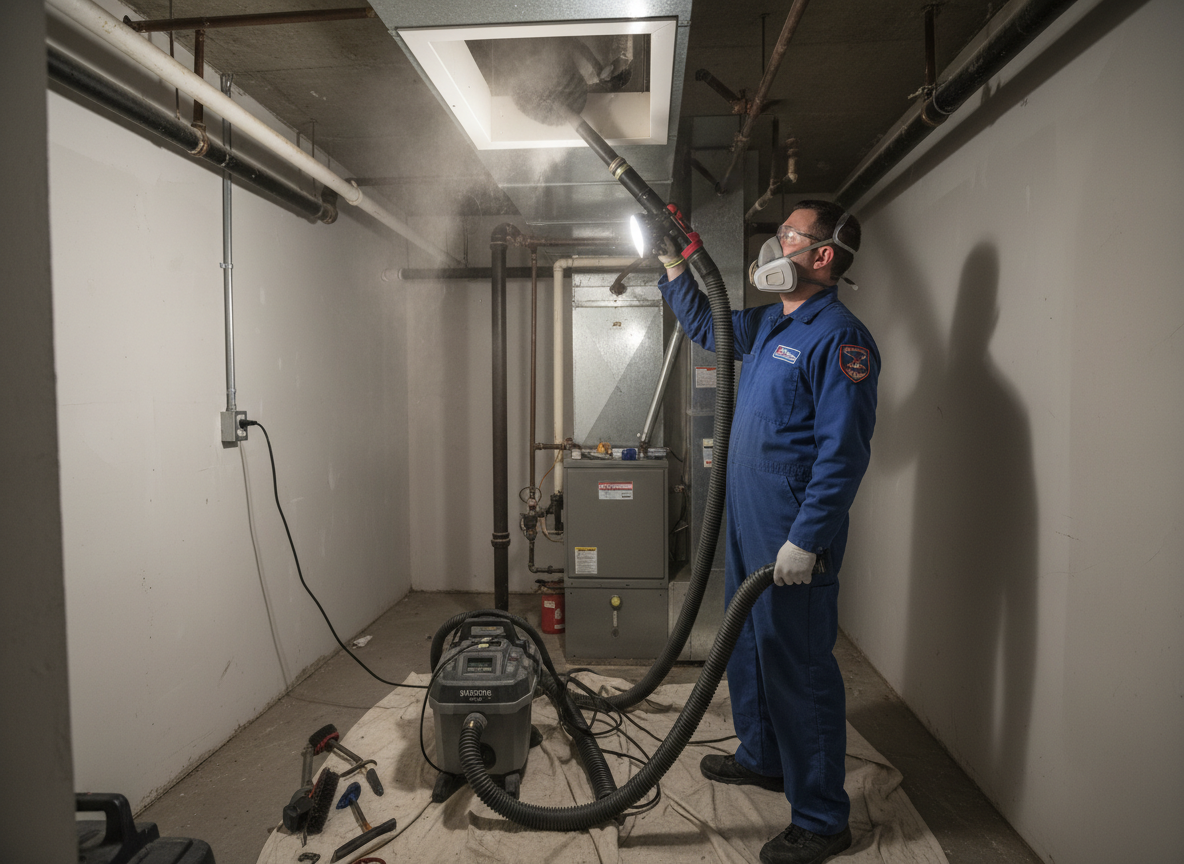
Blue Ash neighborhoods feature many mid-century ranch homes and split-levels built between the 1950s and 1970s, where metal duct runs often travel through basements and crawlspaces that trap humidity during Ohio summers. This setup allows dust, pet hair, and pollen to settle in long horizontal sections that are hard to reach without removing registers and using whips or brushes sized for the original 6-inch and 8-inch trunk lines common here. Homeowners in areas near the Blue Ash Nature Park or along Plainfield Road frequently notice reduced airflow after leaf-drop season when outdoor debris gets pulled into return vents.
Cleaning these systems requires isolating each branch run before agitation to avoid pushing debris into the furnace or air handler, a step that becomes critical in homes with older single-stage equipment still common in Hamilton County. Technicians check for disconnected joints or crushed flex sections near the plenum, conditions that appear often after decades of settling on the area's clay-heavy soil. Proper negative-air capture prevents cross-contamination between floors, especially important in two-story homes near Montgomery or Evendale where family rooms sit above finished basements.
Access Challenges in Local Homes
Ranch-style floor plans in Blue Ash often place supply vents in the center of rooms with limited ceiling access, requiring furniture moving and carpet protection that adds time compared with newer construction. Technicians also inspect for asbestos tape on older joints before any mechanical cleaning begins.
Humidity and Mold Risks
Summer humidity in the Blue Ash area encourages condensation inside uninsulated ducts during cooling cycles, creating conditions where surface mold can form on interior duct walls. Cleaning addresses visible buildup but cannot fix missing insulation or poor drainage around the air handler itself.
Technician insight
In Blue Ash, the thing that catches most people out with air vent cleaning is the 1960s ranch homes where supply ducts run low through finished basements and collect moisture from humid summers, so simple register vacuuming leaves the real buildup untouched until the system is opened at the trunk.
Reduced Airflow in a Blue Ash Split-Level
Homeowners near Plainfield Road noticed weaker airflow on the upper floor after a wet spring. Inspection showed heavy dust and a partially crushed flex connector in the basement run feeding the second level. The team isolated the branch, agitated and extracted debris from the main trunk, replaced the damaged flex section, and restored balanced airflow throughout the house.
How it works
- 1
Initial System Walkthrough
Technician maps every accessible vent and return in the Blue Ash home, noting duct material, size, and any visible damage or disconnection points.
- 2
Register Removal and Protection
Registers are removed and floors covered; furniture is shifted only as needed to reach each opening without unnecessary disruption.
- 3
Agitation and Vacuum Extraction
Rotating brushes and compressed air tools loosen debris while a HEPA vacuum maintains negative pressure from the main trunk line.
- 4
Final Inspection and Reassembly
Each run is checked for remaining material, registers are reinstalled, and the system is tested for restored airflow.
Pricing
Pricing varies by number of vents, home size, and condition of the ductwork.