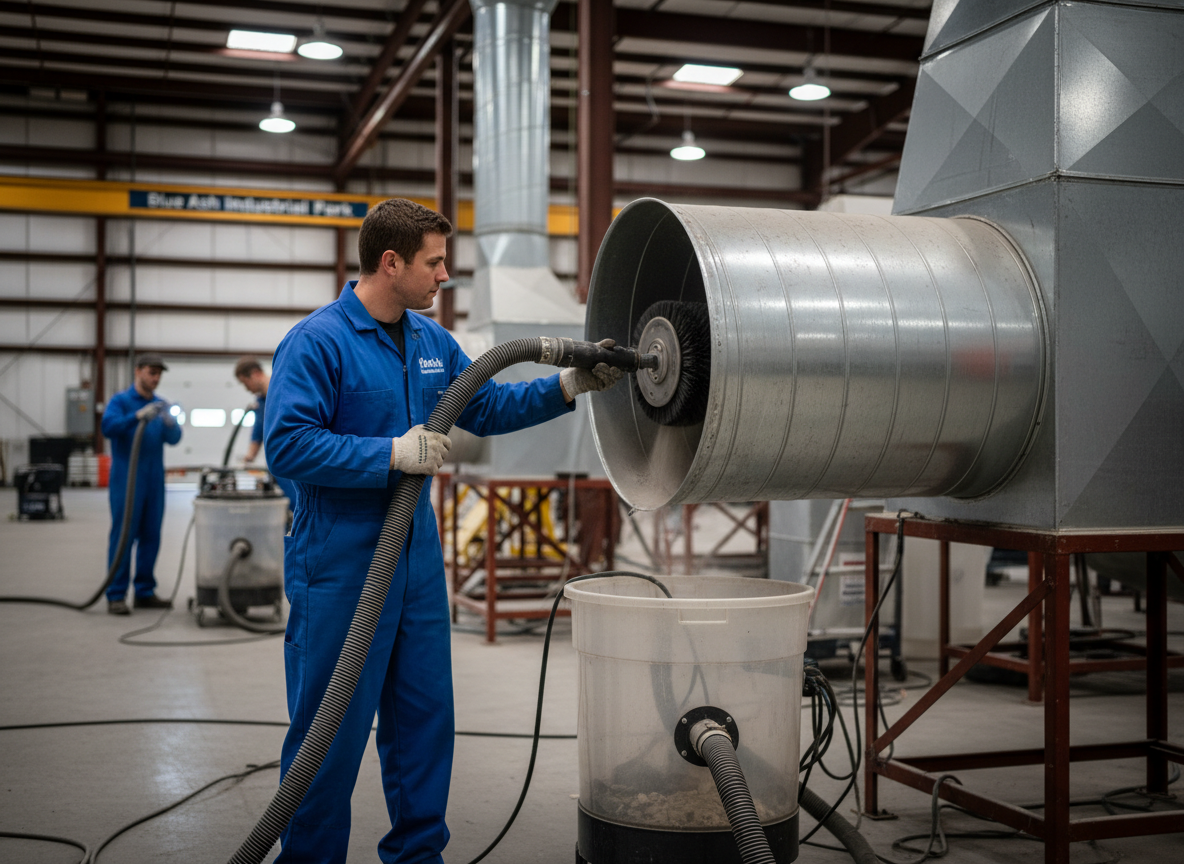
Commercial buildings in Blue Ash often feature older HVAC systems installed when the area developed around the former airport site and nearby business parks. These ducts accumulate construction debris, insulation fibers, and pollen drawn in through rooftop units during humid summers and leaf-drop seasons. Access points are frequently limited to small chaseways above drop ceilings or through mechanical rooms shared with neighboring tenants, requiring careful disassembly to avoid disrupting operations during business hours.
In Hamilton County commercial properties, duct runs commonly pass through unconditioned attics or along exterior walls where temperature swings cause condensation and mold growth on metal surfaces. Cleaning crews must isolate sections with negative-air machines to prevent cross-contamination into occupied spaces, especially in multi-tenant strips along Plainfield Road. Failure to map the full trunk-and-branch layout before starting can leave sections untouched, allowing allergens to recirculate through the same registers.
Technicians verify static pressure and airflow readings before and after each job because commercial blowers are larger and more sensitive to restrictions than residential units. Blue Ash code enforcement may require documentation of debris removal when a tenant changes occupancy, particularly for food-service or medical offices where particulate loads differ. Proper sealing of access doors after cleaning prevents future bypass leaks that increase energy costs during winter heating cycles.
Technician insight
In Blue Ash, the thing that catches most people out with Commercial Air Duct Cleaning is the way older strip-center ductwork along Plainfield Road was routed through shared attic spaces between tenants, so one business's renovation dust ends up in everyone else's returns.
Retail Plaza Near Blue Ash Business Park
A multi-tenant retail building reported inconsistent airflow and musty odors after a neighboring unit underwent renovation. Inspection revealed construction drywall dust had migrated through connected return ducts into three other suites. Crews isolated each tenant space, cleaned the shared trunk lines from the rooftop units down, and restored airflow without interrupting daytime operations.
How it works
- 1
Site Assessment
Walk the mechanical rooms and review as-built drawings to locate all trunk lines, branches, and rooftop connections serving the Blue Ash property.
- 2
Isolation And Containment
Set up negative-air machines and seal off work zones so dust does not migrate into tenant spaces during the cleaning.
- 3
Mechanical Agitation And Extraction
Use rotary brushes and compressed-air whips sized for commercial duct diameters, followed by HEPA vacuum extraction from each section.
- 4
Post-Cleaning Verification
Reconnect components, restore airflow readings, and document cleared sections for the building manager.
Pricing
Cost depends on total linear footage, number of rooftop units, and access difficulty in multi-story or tenant-occupied buildings.