Blue Ash housing stock from the 1960s through 1980s often features original sheet metal duct runs in crawl spaces and basements that trap pollen, pet dander, and construction dust from nearby developments in Montgomery and Evendale. Seasonal swings between humid summers and cold winters drive condensation inside those lines, creating conditions where mold colonies form along joints and elbows. Homeowners notice reduced airflow from registers and musty odors that worsen after heavy rains common in the Ohio River valley.
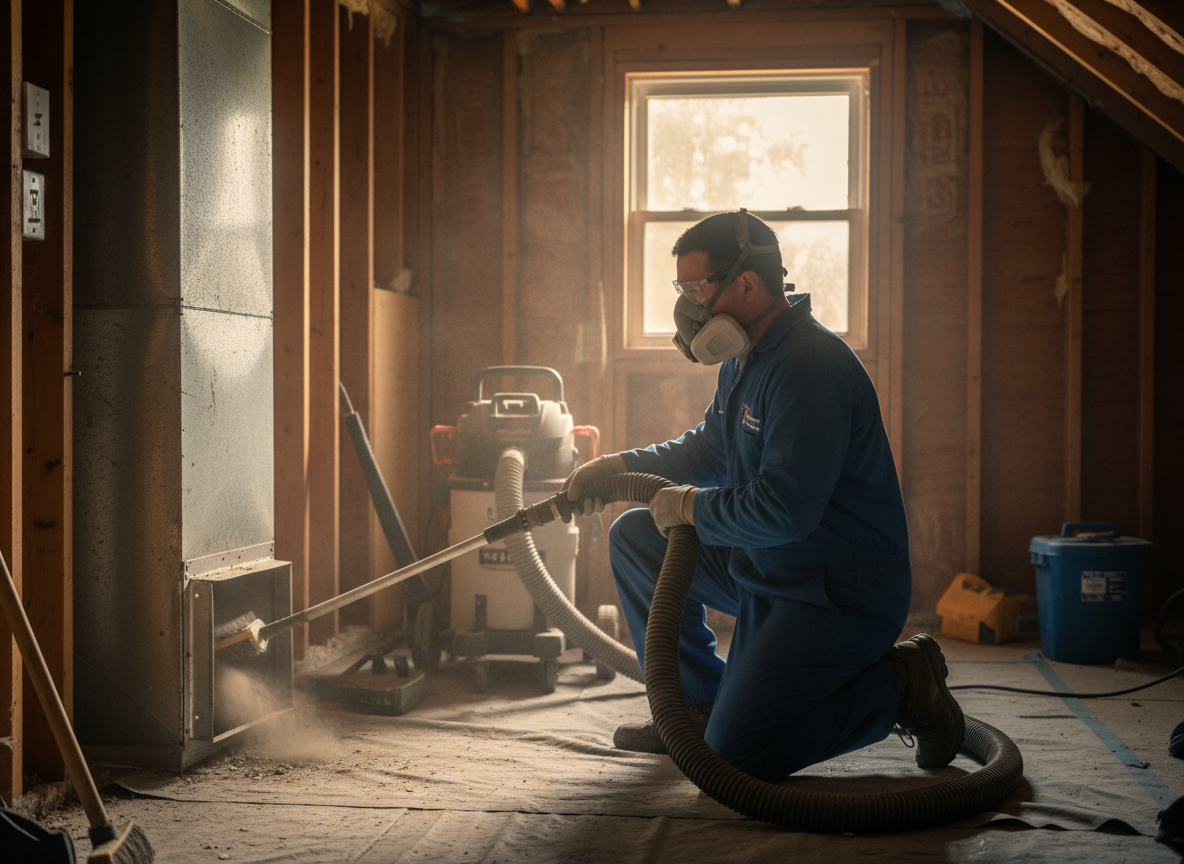
Cleaning starts with negative-pressure equipment connected at the main trunk to capture debris without spreading it through living spaces. Technicians remove and clean registers individually, then use rotating brushes sized for both round and rectangular ducts found in split-level homes around Summit Park. Access panels are cut only when existing openings prove insufficient, and every opening is sealed afterward to maintain system integrity.
In older Blue Ash neighborhoods, tree roots and shifting clay soils can tilt furnace platforms, creating low spots where moisture collects and rust forms on duct seams. Addressing these low spots during cleaning prevents repeat buildup. Homeowners receive a written map of the duct layout showing every access point used and any areas that need future monitoring.
Seasonal Considerations
Ohio winters pull dry heated air through ducts while spring pollen loads filters quickly. Scheduling service after leaf drop but before furnace startup reduces the volume of organic material that gets baked onto interior surfaces during the heating season.
Technician insight
In Blue Ash the thing that catches most people out with air duct cleaning near me is the number of low spots created when 1970s homes settled on the area's clay-heavy soil. Those dips collect moisture every winter and turn into mold factories if the ducts are never opened and dried during service.
Collapsed Return in Montgomery Home
A 1978 split-level near Plainfield Road showed weak airflow on the upper floor. Inspection revealed a crushed return duct under the finished basement ceiling caused by prior water intrusion. We opened the line, removed standing debris and rust scale, reinforced the section, and restored balanced airflow throughout the house.
How it works
- 1
Initial Assessment
Technician inspects visible duct sections, registers, and the furnace or air handler location to identify access points and note any damaged or collapsed runs.
- 2
System Isolation
Registers are sealed and the main trunk is connected to negative-pressure equipment to contain debris during brushing and vacuuming.
- 3
Mechanical Cleaning
Rotating brushes and compressed air tools dislodge buildup from all accessible duct surfaces while the vacuum removes material at the source.
- 4
Final Inspection and Reassembly
Every register is reinstalled, access points are sealed, and airflow is verified at multiple points before the system is returned to normal operation.
Pricing
Cost depends on number of runs, access difficulty, and whether the home has a finished basement or multiple furnace zones.