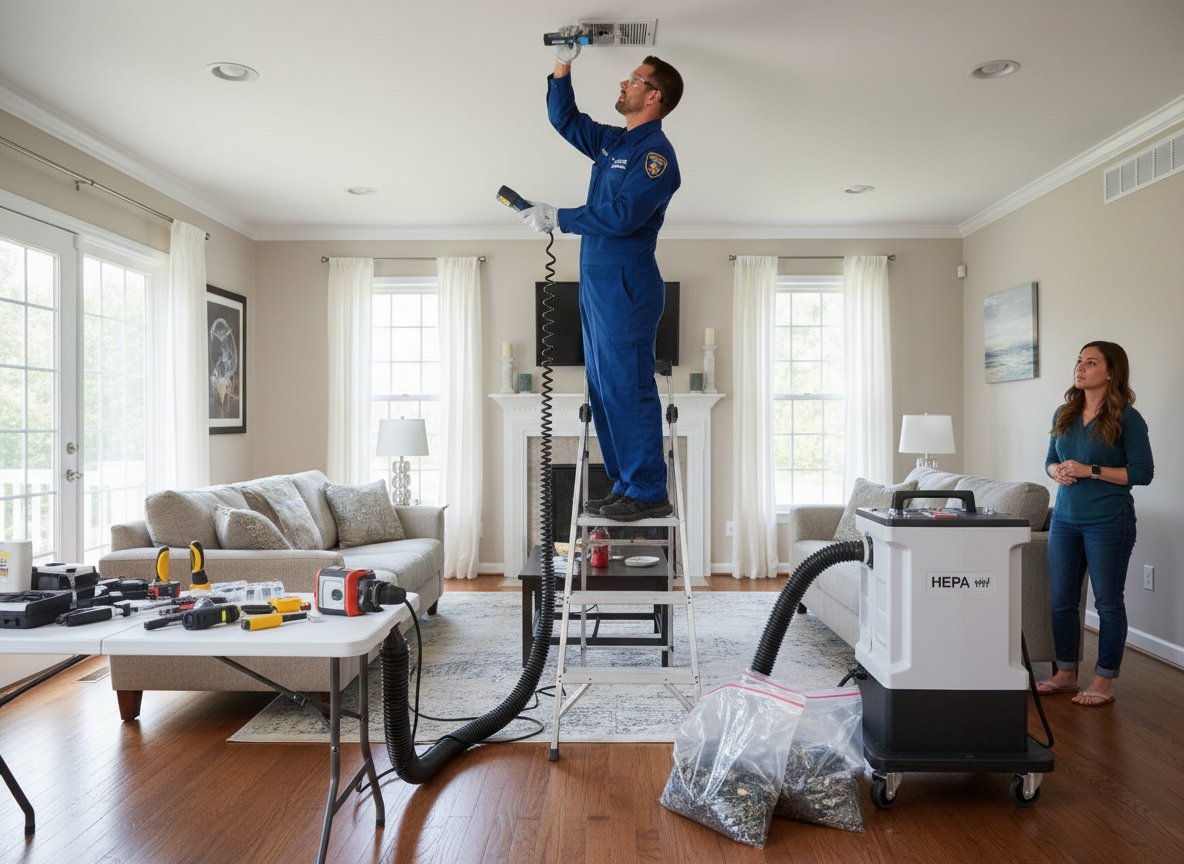
Blue Ash homes often feature duct systems installed in the 1960s through 1980s that run through unconditioned attics and crawlspaces. Seasonal humidity from the Ohio River valley pulls moisture into these lines, creating conditions for mold and dust mite growth that standard filters cannot stop. Technicians at Swift Mend start by mapping each branch with cameras to locate gaps where return air pulls in basement air or attic insulation fibers.
Edge cases appear in split-level houses near the Blue Ash Recreation Center where supply runs cross exterior walls with minimal insulation. Temperature swings cause condensation that rusts metal joints and releases metallic particles into living spaces. Proper sealing requires mastic rather than tape because tape fails after repeated freeze-thaw cycles common in Hamilton County winters.
Filtration upgrades must account for the higher static pressure created by older furnaces common on streets like Plainfield Road. Adding a whole-home filter without adjusting blower speed can reduce airflow and create hot and cold spots. Swift Mend measures static pressure before and after any change to keep equipment within manufacturer limits.
Pollen counts spike in spring near the Little Miami River corridor, and ragweed follows in late summer. Residents notice increased allergy symptoms when ducts have not been cleaned since the previous heating season. Targeted cleaning of return plenums and supply registers removes the bulk of accumulated debris without requiring full system replacement.
Technician insight
In Blue Ash, the thing that catches most people out with indoor air quality services is how many 1970s ranch homes around Plainfield Road have supply ducts running through uninsulated crawlspaces that sit below the water table after heavy spring rains. Moisture gets drawn into the system every time the blower runs, and homeowners keep replacing filters without ever addressing the source.
Crawlspace Moisture in Split-Level Home
A homeowner near the Blue Ash Nature Preserve reported persistent musty odors and increased allergy symptoms. Inspection showed supply ducts in the crawlspace pulling damp air through separated joints. Crew sealed the joints with mastic, added a vapor barrier under the main trunk, and installed a higher-capacity filter. Follow-up readings showed static pressure returned to normal range and odors resolved.
How it works
- 1
Initial Assessment
Camera inspection of all accessible duct runs and measurement of static pressure to identify leaks and contamination sources.
- 2
Source Removal
Negative-air vacuuming combined with agitation tools to extract dust, insulation fibers, and any visible mold from supply and return lines.
- 3
Sealing and Repair
Application of mastic sealant at joints and replacement of damaged flex runs that have separated due to settling.
- 4
Filtration Upgrade
Installation of higher-MERV filters or UV lights sized to the existing blower capacity with post-install pressure verification.
Pricing
Upfront quotes provided after inspection; cost depends on number of runs, access difficulty, and any sealing or filtration additions required.