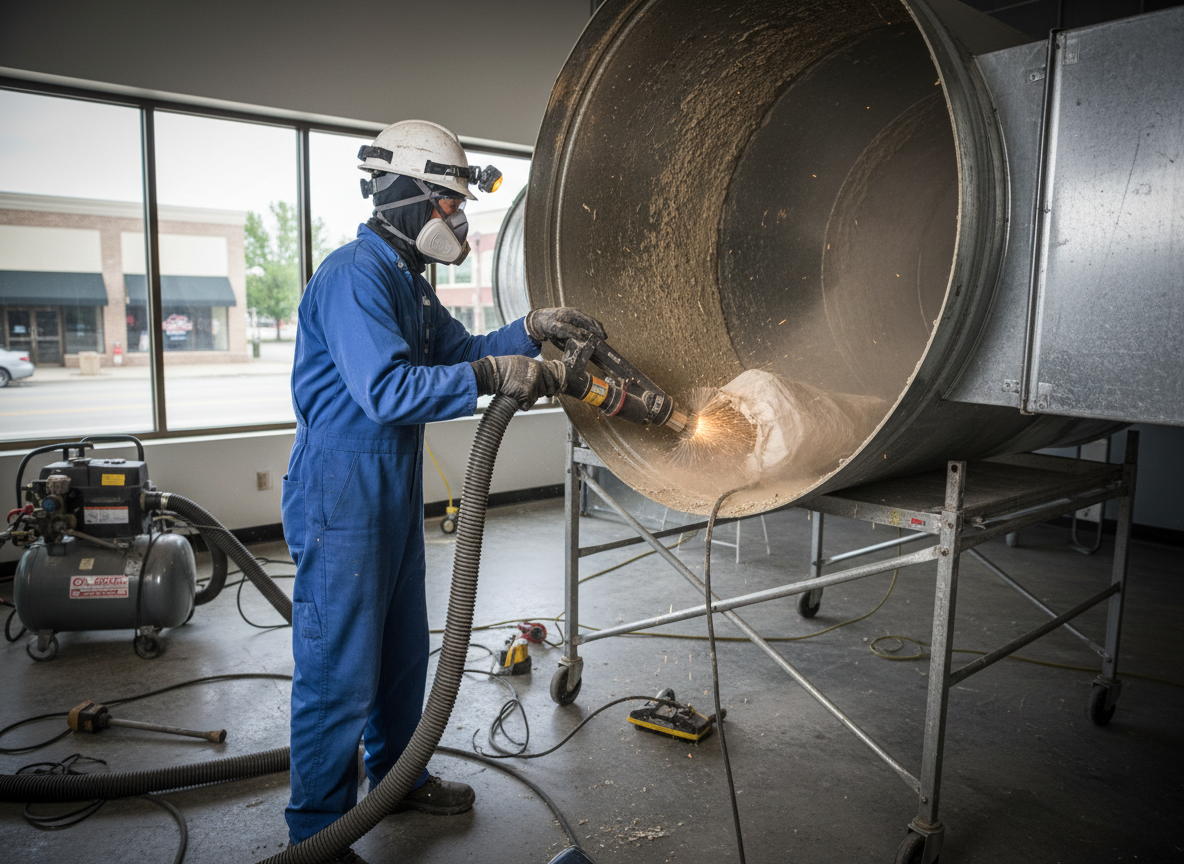
Industrial facilities in Blue Ash often run long duct runs through older warehouses and light manufacturing buildings near Plainfield Road and surrounding Hamilton County zones. Dust from production processes, combined with Ohio's humid summers and cold winters, packs into trunk lines and branches, raising static pressure and forcing HVAC units to work harder. Technicians access these systems through rooftop units or mechanical rooms, using negative-air machines and agitation tools sized for larger diameters than residential work. Neglected lines can spread contaminants across open floor plans, so mapping the full layout before starting prevents missed sections that recirculate debris.
Access challenges appear in Blue Ash industrial buildings where ducts run above suspended ceilings or through tight crawl spaces with limited entry points. Technicians must isolate zones to avoid shutting down entire operations, often working overnight or during scheduled downtime. Metal duct seams from earlier construction eras can loosen under repeated cleaning passes, requiring on-site reinforcement rather than full replacement. Moisture from nearby roof leaks or poor drainage around the building foundation adds another layer, creating conditions where mold colonies form inside insulated sections and demand antimicrobial treatment after debris removal.
Post-clean verification in these settings includes visual inspection with borescopes and airflow readings at multiple registers to confirm pressure drops have returned to design specs. Blue Ash facilities near major roads see extra particulate from traffic that settles faster in high-volume systems, so filters get checked and replaced as part of the same visit. Crews document every access point and seal them properly to maintain the building's fire-rated separations. This approach keeps equipment running reliably through seasonal shifts without repeated emergency calls.
Technician insight
In Blue Ash, the thing that catches most people out with Industrial air duct cleaning is older warehouse ductwork that was never designed for modern production loads; the seams start leaking after the first deep clean and you have to reinforce them on the spot or the negative pressure pulls in attic dust from the roof deck.
Warehouse line shutdown avoided
A Blue Ash manufacturing plant reported rising energy use and visible dust on finished goods. Inspection showed packed debris in a 24-inch trunk running above the assembly floor. Crews isolated the line overnight, extracted the buildup, and reinforced two failing seams. Airflow readings returned to spec and production resumed the next shift without further complaints.
How it works
- 1
Site Assessment
Map all accessible duct sections, note equipment locations, and identify isolation points in the Blue Ash facility.
- 2
Zone Isolation
Set up containment and negative air to protect production areas while work proceeds.
- 3
Agitation and Extraction
Run whips and brushes through lines while HEPA units pull debris out of the system.
- 4
Final Verification
Inspect cleaned sections and confirm airflow readings before restoring full operation.
Pricing
Cost depends on total linear feet, number of access points required, and whether overnight scheduling is needed.