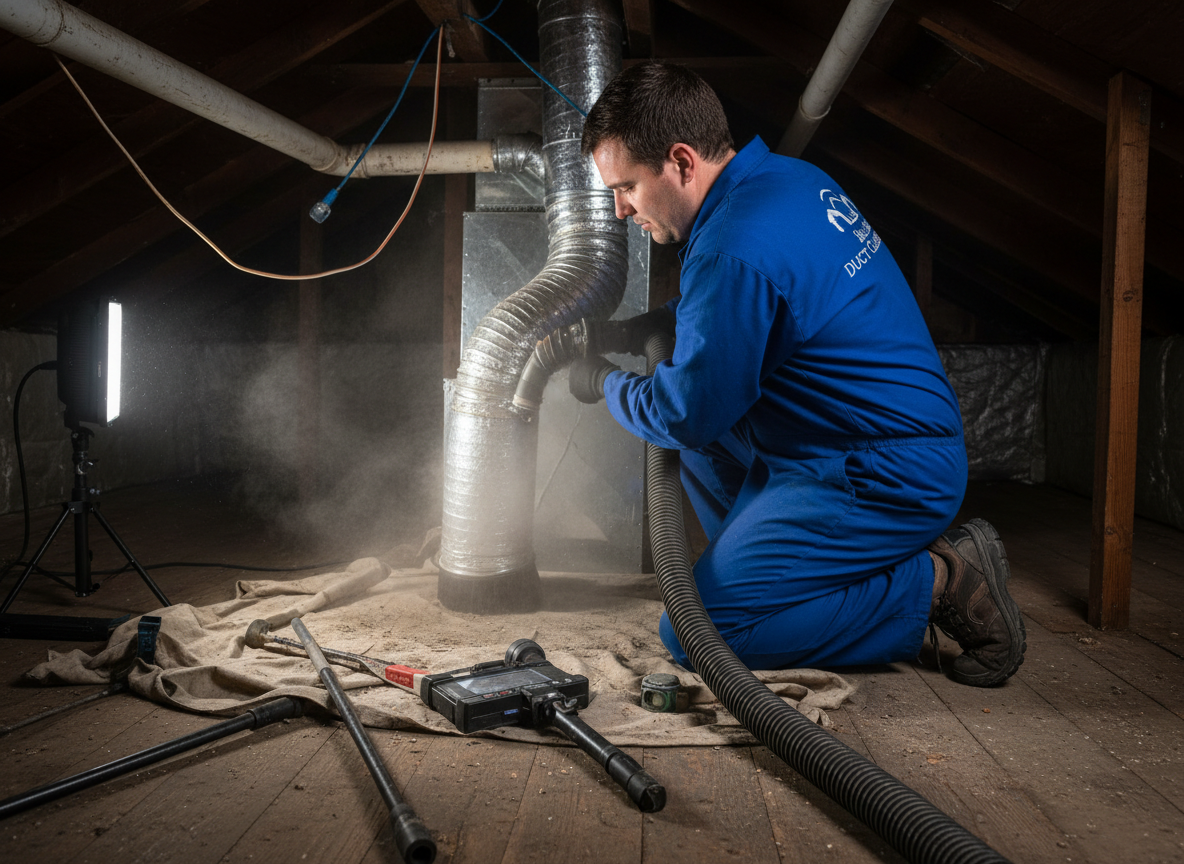
Blue Ash homes built from the 1950s through the 1980s often feature galvanized steel ductwork routed through crawl spaces and basements that collect fine Ohio River Valley silt and winter heating residue. Over time this material restricts airflow and feeds back into living spaces during the long heating season. Cleaning crews must disassemble sections at the plenum and use negative-air machines sized for the typical 1,800- to 2,400-square-foot ranch and split-level layouts found along Plainfield Road and surrounding streets.
Summer humidity combined with winter furnace operation creates condensation points inside supply runs near exterior walls, encouraging mold on paper-lined insulation. Technicians check for loose joints and crushed flex duct common where additions were tied into original systems. Proper brushing and vacuum extraction prevents the fine particles from being pushed back into rooms once the system restarts.
Residents near the former Blue Ash Airport and along Hunt Road frequently report higher pollen loads in spring that settle in return grilles. A full cleaning includes removing these grilles, vacuuming the boots, and confirming that dampers still operate freely after years of seasonal cycling. Skipping this step leaves airflow imbalances that homeowners notice as uneven temperatures between floors.
Access limitations in finished basements require smaller whips and careful protection of stored items. Crews also verify that the furnace filter slot is not blocked by accumulated debris before leaving the site, because a clean duct system performs only as well as the filter that follows it.
Technician insight
In Blue Ash the thing that catches most people out with local air duct cleaning is the number of homes from the 1960s and 70s where the original ductwork runs under finished basement ceilings with almost no access panels; once you open a section you often find crushed flex or disconnected joints that homeowners never knew existed.
Split-Level on Hunt Road
Homeowner noticed uneven airflow between the upper and lower levels after the first cold snap. Inspection showed heavy dust and a partially collapsed flex run where an addition had been tied into the original trunk. Crews replaced the damaged section, completed full extraction, and restored balanced airflow throughout the house.
How it works
- 1
Initial Walk-Through
Technician inspects all accessible supply and return runs, notes access points, and checks for damaged sections typical in Blue Ash basements.
- 2
System Isolation
Registers and grilles are removed or covered; the furnace and air handler are sealed to create a contained cleaning zone.
- 3
Agitation and Extraction
Rotating brushes and compressed-air whips loosen debris while a HEPA vacuum draws material out through the main trunk.
- 4
Final Inspection and Reassembly
Ducts are checked for remaining residue, components are reassembled, and the system is run to confirm proper airflow.
Pricing
Cost depends on number of runs, access difficulty, and whether dryer vents or HVAC components need separate attention.